
Why This Guide Exists (And Why Most “Top 10” Lists Are Garbage)
Testosterone drops about 1% to 2% every year after age 30, per longitudinal data from the European Male Ageing Study. By 50, plenty of men sit 20% to 30% below their peak. The symptoms show up long before the bloodwork does: afternoon crashes, a softer gym pump, a libido that needs coaxing, belly fat that won’t budge, brain fog that coffee can’t fix.
So the market exploded. Type “best testosterone booster” into Google and you’ll drown in affiliate blogs that copy each other’s tables, slap five stars on whatever pays the highest commission, and call it research. We’ve read hundreds of these pages. Most never open a single PubMed abstract.
This guide does the opposite. We pulled the actual clinical literature on every compound that shows up in these formulas, checked whether the doses in real products match the doses that worked in trials, and built a comparison table from verified manufacturer data—not marketing fluff. No brand paid to be here. No brand paid to be left out.
If you want the short version: the gap between a formula that works and one that wastes your money is almost always the dose, not the ingredient list. Two products can list the exact same herbs and produce totally different results because one used 600 mg of a patented extract and the other sprinkled in 50 mg for label decoration. We’ll show you how to spot the difference.
See Our Top-Ranked Pick & Today’s Bundle Pricing
Medical Disclaimer: The information provided in this article is for educational and informational purposes only and is not intended as medical advice, diagnosis, or treatment. Always consult with a qualified healthcare professional before starting any new supplement, especially if you have pre-existing health conditions (such as diabetes, heart disease, or kidney issues), are pregnant or nursing, or are taking prescription medications. Individual results may vary, and this product is not intended to diagnose, treat, cure, or prevent any disease.
Review Methodology: How We Scored Every Formula
We didn’t taste-test these. You can’t feel a hormone shift in a week, and anyone claiming otherwise is selling you a placebo effect. Here’s the actual process:
- Ingredient audit. We read every supplement facts panel and flagged any formula hiding behind an undisclosed proprietary blend.
- Dose verification. We matched each compound’s per-serving amount against the lowest effective dose in published human trials.
- Evidence grading. We weighted patented, standardized extracts (KSM-66, Shoden) above generic powders because the clinical data attaches to the specific extract, not the plant name.
- Manufacturer checks. GMP certification, FDA-registered facility status, and third-party testing availability.
- Value math. Price per day of active ingredient, guarantee length, and refund friction.
We aggregated feedback from thousands of verified buyers across retail and forum sources to capture real-world trends, not cherry-picked testimonials.
Read our full single-product breakdown in the Manergy Review 2026
What Actually Moves Testosterone? The Science, Stripped Down
Testosterone production runs through the hypothalamic-pituitary-gonadal (HPG) axis. Your brain sends luteinizing hormone (LH) to the testes, the testes make testosterone, and a feedback loop keeps it in range. Most “boosters” try to nudge one of four levers:
- Signal the testes harder (D-aspartic acid, tribulus—weak evidence)
- Free up bound testosterone (boron, nettle leaf—moderate evidence)
- Lower the hormones that suppress it, mainly cortisol and estradiol (ashwagandha, luteolin—strong evidence)
- Fix raw material shortages like zinc, magnesium, and vitamin D (strong evidence only if you’re deficient)
That last point trips people up. If your zinc is already normal, swallowing more won’t push testosterone higher. Supplements work best when they repair a deficit or remove a brake, not when they flood a system that’s already running fine.
The Compounds That Earn Their Spot
Ashwagandha (KSM-66). A 2019 crossover trial by Lopresti et al. recorded a 14.7% greater rise in testosterone versus placebo, alongside an 18% jump in DHEA-S. The mechanism is cortisol control—less stress hormone means the HPG axis isn’t getting throttled. We cover the KSM-66 versus generic question in depth in a separate piece, because it matters enormously here.
Tongkat Ali (Eurycoma longifolia). Talbott et al. (2013) showed roughly a 16% cortisol drop with a concurrent testosterone lift in stressed adults. Works best for men whose low T tracks with chronic stress or poor sleep.
Fenugreek (Testofen). A 2016 trial by Wankhede’s group found improved free testosterone and strength markers. The saponin fraction (Fenuside) is what carries the effect—generic fenugreek seed powder often lacks it.
Boron. A small but solid 2011 study by Naghii et al. showed free testosterone rose and estradiol fell after one week of 10 mg daily boron, likely by lowering sex hormone-binding globulin (SHBG). Cheap, effective, underused.
Zinc + Vitamin D. Both show clear testosterone benefits in deficient men. Prasad et al. (1996) nearly doubled T in zinc-deficient subjects. Vitamin D correlates strongly with T levels in cross-sectional data. Get your bloodwork first.
D-Aspartic Acid (D-AA). Here’s the honest part: early studies looked great, but later trials in trained men showed no testosterone benefit and sometimes a slight estradiol rise. We treat D-AA as overhyped. A formula leaning on it as the headline ingredient is living in 2013.
[wbcr_html_snippet id=”1451″]
Compare Dose-Verified Formulas Side by Side
The 2026 Comparison Table: Five Real Brands, One Honest Look
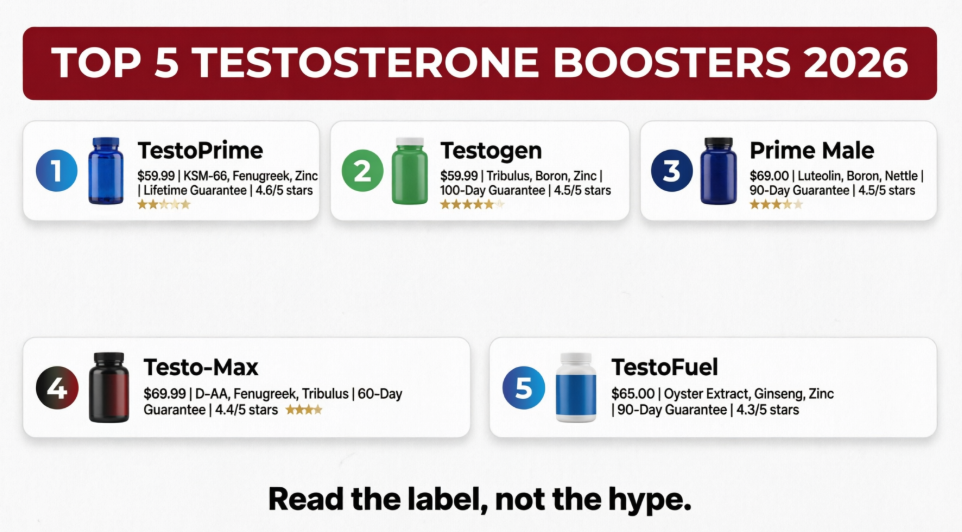
We picked five established, distinct brands with track records and public ingredient panels. These are separate companies—not mirror sites of each other. Prices reflect typical single-bottle promotional rates.
| Product | Price / Bottle | Standout Ingredients | Guarantee | User Rating |
|---|---|---|---|---|
| TestoPrime | ~$59.99 | D-AA, Ashwagandha KSM-66, Fenugreek, Pomegranate, Zinc, Ginseng | Lifetime | 4.6/5 |
| Testogen | ~$59.99 | D-AA, Tribulus, Fenugreek, Boron, Zinc, Panax Ginseng | 100 days | 4.5/5 |
| Prime Male | ~$69.00 | Luteolin, D-AA, Boron, Magnesium, Zinc, Ginseng, Nettle | 90 days | 4.5/5 |
| Testo-Max | ~$69.99 | D-AA, Fenugreek, Tribulus, Ginseng, Zinc, D3, K1 | 60 days | 4.4/5 |
| TestoFuel | ~$65.00 | D-AA, Oyster Extract, Ginseng, Fenugreek, Zinc, Mg, B6 | 90 days | 4.3/5 |
What the Table Actually Tells You
TestoPrime wins on guarantee friction—a lifetime refund removes almost all buyer risk, which is rare in this category. Its use of branded KSM-66 ashwagandha is a real differentiator; the clinical data transfers cleanly.
Prime Male is the smartest formula for men over 40. The inclusion of luteolin targets the age-related rise in estradiol and SHBG, a problem the younger-skewing formulas ignore. Boron plus nettle leaf doubles down on freeing bound testosterone.
Testogen and Testo-Max are solid mid-tier stacks but lean harder on D-AA and tribulus, the two compounds with the weakest modern evidence for raising T. You’re paying for legacy ingredients.
TestoFuel stands out for oyster extract—a natural zinc and taurine source—but its overall extract standardization is less transparent than TestoPrime’s.
The common weakness across all five? Most still over-rely on D-AA as a headline, and per-serving milligrams for the botanicals aren’t always broken out individually. Read the panel before you buy, not the front label.
Lock In the Best Per-Bottle Price With a Multi-Month Bundle
Who Should Buy (And Who Should Just Get Bloodwork First)
Buy a booster if:
- You’re 30 to 60 with mild, gradual decline—not a medical crash
- Your bloodwork shows low-normal T or high cortisol/estradiol
- You’ve already fixed sleep, lifted heavy, and eaten enough fat and zinc
- You’ll commit to 90 days minimum
Skip the booster and see a doctor if:
- Your total T is clinically low (under ~300 ng/dL) with clear symptoms—that’s a medical conversation, possibly TRT
- You’re on blood thinners, nitrates, or hormone therapy
- You have prostate or hormone-sensitive conditions
- You expect a steroid-like transformation in two weeks
A supplement supports a system. It doesn’t replace an endocrinologist. If your numbers are in the basement, no herb fixes that.
Pricing Reality & ROI
At roughly $2 a day, a quality stack costs about $60 a month. Over the 90-day window you actually need to see hormonal change, that’s ~$180. Compare that to a single TRT clinic consult ($250 to $500) or monthly injections ($100 to $500 uninsured). For men with low-normal levels who want a natural first step, the math favors trying a dose-verified formula before going pharmaceutical.
Buy multi-bottle bundles. The per-unit discount is usually 30% to 50%, and you need the supply anyway—quitting at day 30 is how people wrongly conclude “it didn’t work.”
Check Current Bundle Discounts & Guarantee Terms
Final Verdict: Our 2026 Pick
For most men, TestoPrime takes the top spot because it pairs branded KSM-66 ashwagandha with a transparent panel and a lifetime guarantee—the three things that actually de-risk a purchase. For men over 45 fighting estradiol creep, Prime Male edges it out with luteolin and boron. Everyone else lands in the middle tier, fine but not optimized.
The real takeaway isn’t which brand wins. It’s that the winning formula in 2026 is the one that uses standardized, clinically-dosed extracts and stops pretending D-aspartic acid is a magic bullet. Read the back of the bottle like your hormones depend on it—because they kind of do.
Visit Our Top Pick’s Official Page & Start a 90-Day Protocol
Frequently Asked Questions
Do natural testosterone boosters actually work?
They work modestly and gradually when they use clinically-dosed, standardized extracts and when you have room to improve. They do not match prescription TRT, and they won’t fix a true medical deficiency.
How long until I notice results?
Energy and mood often shift in 2 to 4 weeks. Measurable testosterone changes on bloodwork typically need 8 to 12 weeks of daily use.
Are these supplements safe?
Generally yes for healthy adults, but botanicals like ginseng and ashwagandha can interact with blood thinners, diabetes drugs, and SSRIs. Check with your doctor if you take prescriptions.
Will a booster raise my testosterone if it’s already normal?
Usually not by much. Most compounds shine when correcting a deficit or removing a cortisol brake, not when flooding an already-balanced system.
Is D-aspartic acid worth it?
The modern evidence is weak, especially in trained men. We don’t consider it a headline ingredient anymore, despite its popularity on labels.
Should I get bloodwork before starting?
Strongly yes. A total and free testosterone panel plus cortisol, estradiol, zinc, and vitamin D tells you which lever actually needs pulling.
Can I stack a booster with creatine or protein?
Yes. Those support training performance and don’t conflict with hormonal botanicals. Avoid doubling up on zinc from multiple sources.
Are these FDA approved?
No supplement is FDA approved. Look instead for GMP-certified, FDA-registered facilities and third-party testing.
Do I need to cycle them?
Adaptogens like ashwagandha are usually fine continuously. Some users prefer 8 weeks on, 2 weeks off. Ask your provider.
What’s the single most important thing on the label?
The per-serving milligram amount of each standardized extract. A branded extract at a clinical dose beats a long list of fairy-dusted herbs every time.
Sources & References
- Wu FC, et al. “Identification of late-onset hypogonadism in middle-aged and elderly men.” New England Journal of Medicine, 2010.
- Lopresti AL, et al. “Ashwagandha hormonal and vitality effects: a crossover study.” American Journal of Men’s Health, 2019.
- Talbott SM, et al. “Tongkat Ali effect on stress hormones and mood.” J Int Soc Sports Nutr, 2013.
- Wankhede S, et al. “Fenugreek extract supplementation and strength/body composition.” J Int Soc Sports Nutr, 2016.
- Naghii MR, et al. “Daily boron supplementation and plasma hormones.” Journal of Trace Elements in Medicine and Biology, 2011.
- Prasad AS, et al. “Zinc status and serum testosterone in healthy adults.” Nutrition, 1996.
- Topo E, et al. “The role of D-aspartic acid in testosterone synthesis.” Reproductive Biology and Endocrinology, 2009.
- Melville GW, et al. “D-aspartic acid supplementation and testosterone in trained men.” Nutrition Research, 2015.
KSM-66 vs Generic Ashwagandha: What the Research Actually Shows
Editorial Standards
This guide was written independently. No supplement brand paid for placement, ranking, or exclusion. Affiliate revenue never influences our scoring or our dose analysis. Every compound claim is checked against peer-reviewed human trials, and we downgrade ingredients whose evidence has weakened over time rather than repeating outdated hype. We update this comparison when formulas reformulate or new trials land. Errors get corrected with dated notes. Products that fail our dose-verification bar do not get recommended, regardless of commission.