
Two Bottles, Same Plant, Wildly Different Results
Walk into the ashwagandha aisle—physical or digital—and every label promises the same thing: less stress, more energy, better hormones. The price tags range from $9 to $40. The plant name is identical on all of them. So why does one guy swear his cortisol melted away while another feels absolutely nothing?
Because “ashwagandha” on a label tells you almost nothing. The difference between a patented, full-spectrum root extract standardized to a known withanolide level and a cheap leaf-and-root powder is the difference between a measured dose of medicine and a handful of dried leaves. The clinical trials you keep hearing about? They used specific extracts, mostly KSM-66. The cheap bottle on the shelf probably didn’t.
This piece breaks down exactly what KSM-66 is, what generic ashwagandha actually means, and—most importantly—whether the research you’re citing applies to the product in your cart. We’ll get brutally specific about withanolide percentages, extraction methods, and the trials that do and don’t transfer. If you’ve ever wondered why your supplement “didn’t work,” the answer is probably hiding in this distinction.
Medical Disclaimer: The information provided in this article is for educational and informational purposes only and is not intended as medical advice, diagnosis, or treatment. Always consult with a qualified healthcare professional before starting any new supplement, especially if you have pre-existing health conditions (such as diabetes, heart disease, or kidney issues), are pregnant or nursing, or are taking prescription medications. Individual results may vary, and this product is not intended to diagnose, treat, cure, or prevent any disease.
→ [CTA 1: See Supplements That Use Verified KSM-66 at Clinical Doses]
What KSM-66 Actually Is (Not Marketing—Chemistry)
KSM-66 is a patented, full-spectrum root-only extract made by Ixoreal Biomed. Three things set it apart, and all three matter for whether the clinical data applies to you:
- Root only. Traditional Ayurvedic use and most research focus on the root, not the leaves. Leaves contain withaferin A, a compound with different (and at high doses, more cytotoxic) activity. KSM-66 excludes leaves to keep the withanolide profile consistent and aligned with the trials.
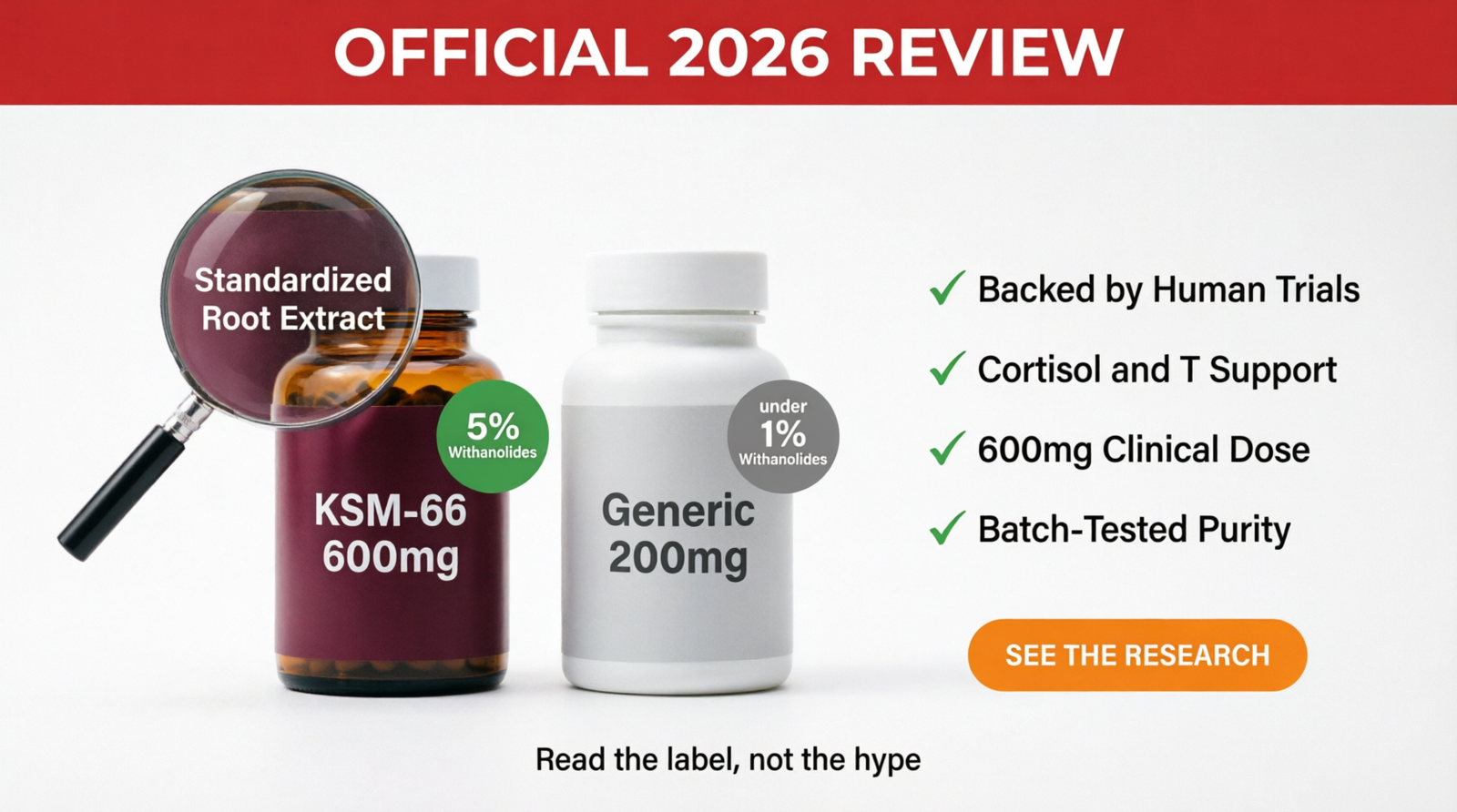
- Standardized to 5% withanolides. Withanolides are the active steroidal lactones. KSM-66 guarantees a minimum of 5% by HPLC, batch after batch. Generic extracts swing wildly—sometimes under 1%.
- Green-chemistry extraction. It uses a milk-preconditioning and water-based process, no harsh synthetic solvents. That affects both purity and the ratio of withanolides preserved.
The result is a reproducible ingredient. When a study says “600 mg of KSM-66,” a manufacturer using KSM-66 can match that dose and that profile exactly. That reproducibility is the entire reason the evidence transfers.
What “Generic Ashwagandha” Really Means
“Generic” isn’t one thing—it’s a grab bag. It can mean:
- A raw root powder with no standardization (withanolides unknown, often 0.5% to 1.5%)
- A leaf-and-root blend, cheaper to produce, with a different and less-studied compound profile
- A solvent-extracted concentrate standardized to a number that may not match the trials’ ratio
None of these are automatically bad. But none of them are what the headline studies tested. So when a blog claims “ashwagandha raised testosterone 17%,” and your bottle is generic leaf powder at 150 mg, you’re borrowing someone else’s data for a product that doesn’t qualify.
[wbcr_html_snippet id=”1463″]
The Research: Which Trials Apply to Which Extract?
Here’s the part almost no comparison article gets right. We mapped the major human trials to the exact extract they used.
| Study | Extract Used | Dose | Key Finding |
|---|---|---|---|
| Lopresti 2019 | KSM-66 | 600 mg | +14.7% testosterone, +18% DHEA-S vs placebo |
| Chauhan 2022 | KSM-66 | 600 mg | Better sexual well-being scores + serum T rise |
| Wankhede 2015 | KSM-66 | 300 mg 2x/day | Greater muscle mass, strength, fat loss in trained men |
| Chandrasekhar 2012 | KSM-66 | 300 mg 2x/day | Cortisol down ~27%, stress scores down |
| Pratte 2014 (review) | Mixed | varied | Anxiolytic effect across extracts, but heterogeneous |
| Sensoril trials | Sensoril | 125-250 mg | Stress/sleep benefits, leaf+root, 10% withanolides |
Read that table slowly. The testosterone and muscle-mass wins—the ones that drive most male supplement sales—come from KSM-66 specifically, at 300 to 600 mg. Sensoril is a legitimate patented extract too, but it’s leaf-and-root with a different withanolide ratio, so you can’t paste the KSM-66 muscle data onto it. And raw generic powder? It has almost no direct trial at a matched dose.
Does that mean generic ashwagandha does nothing? No. It likely still calms you down a bit—the anxiolytic effect is fairly robust across preparations. But the precise hormonal and body-composition outcomes are tied to the standardized root extract. The label decides which study you’re actually running on your own body.
→ [CTA 2: Grab a KSM-66 Formula Dosed at the Studied 600 mg]
Bioavailability & Dose: The Hidden Trap
Even with the right extract, the dose has to land. The cortisol and testosterone trials used 600 mg per day of KSM-66 (or 300 mg twice daily). The strength study used 600 mg total as well.
Now look at a typical multi-ingredient “testosterone booster” or “stress gummy.” If ashwagandha is one of twelve ingredients in a 1,500 mg proprietary blend, the ashwagandha share might be 100 to 200 mg—and possibly not even KSM-66. You’ve now failed on two axes at once: wrong extract and wrong dose. That’s the fairy-dusting problem in action, and it’s the single biggest reason people conclude “ashwagandha is overhyped.” It isn’t. Their bottle is.
A clean rule of thumb: if the label doesn’t say KSM-66 (or another named patented extract) and list at least 300 mg per serving, treat any hormone or strength claim as borrowed goods.
Sensoril vs KSM-66: A Quick Honest Note
Sensoril (Natreon) standardizes to 10% withanolides and includes leaves, so it’s more concentrated by weight and shines in stress and sleep studies at lower doses (125 to 250 mg). It’s a fine product for anxiety and rest. But for the testosterone and muscle endpoints men usually chase, KSM-66 has the direct evidence. Pick the extract that matches your goal, not the bigger percentage number.
How to Read the Label Like a Pro
Next time you shop, run this checklist in order:
- Named extract? Look for “KSM-66,” “Sensoril,” or “Shoden.” A trademark name means traceable standardization.
- Root only or leaf+root? Root-only matches the hormone trials.
- Withanolide %? 5% for KSM-66. Lower than 2.5% with no patent name is a red flag.
- Per-serving mg, not per-bottle. 600 mg daily is the studied range for stress and T.
- Third-party COA available? Reputable brands publish certificates of analysis. No COA on request? Walk away.
Five checks. Thirty seconds. The difference between a result and a refund.
→ [CTA 3: Compare KSM-66 Products With Published Lab Testing]
Safety, Interactions, and Who Should Skip It
Ashwagandha is well tolerated in trials, with mild digestive upset as the most common complaint. But “natural” isn’t “risk-free”:
- Thyroid conditions. Ashwagandha may raise thyroid hormone output—risky if you’re hyperthyroid or on thyroid meds.
- Diabetes medications. It can lower blood sugar, compounding metformin or insulin.
- SSRIs and sedatives. Additive calming effects can tip into drowsiness.
- Autoimmune disease. It stimulates immune activity, which some conditions don’t want.
- Pregnancy and nursing. Avoid—uterine-stimulating withanolides are a concern.
Rare case reports link high-dose ashwagandha to liver enzyme changes, mostly tied to non-standardized products. Another quiet argument for buying a tested, patented extract over a no-name powder.
→ [CTA 4: Choose a Verified, Lab-Tested KSM-66 Source]
Final Verdict: The Label Is the Whole Game
KSM-66 isn’t magic. It’s reproducibility. The reason the testosterone, cortisol, and strength studies look so clean is that every subject got the same standardized root extract at the same dose. Generic ashwagandha can still take the edge off stress, but it doesn’t carry the same evidence for hormones or body composition, and the dose on most cheap labels doesn’t reach the studied range anyway.
So the answer to “KSM-66 vs generic” isn’t really about the plant. It’s about whether you want the version that was actually tested. If your goal is measurable hormonal support or training adaptation, pay the small premium for the named, root-only, 600 mg extract. If you just want a mild wind-down before bed, a decent generic may do the job for less. Match the extract to the outcome, read the milligrams, and stop letting the front label do your thinking.
→ [CTA 5: Start a 600 mg KSM-66 Protocol From a Trusted Brand]
Frequently Asked Questions
Is KSM-66 really better than regular ashwagandha?
For the outcomes studied with KSM-66—testosterone, cortisol, muscle mass—yes, because the trials used that exact extract at 300 to 600 mg. Generic powder lacks matched evidence at those doses.
What withanolide percentage should I look for?
KSM-66 guarantees 5%. Below 2.5% with no patent name usually means a weak, unstandardized product.
Why does root-only matter?
The hormone and strength trials used root extracts. Leaves add withaferin A, changing the compound profile away from what was tested.
Can I get the same effect with a cheaper bottle?
For mild stress relief, sometimes. For hormonal or body-composition goals, probably not, since cheap bottles often miss both the right extract and the right dose.
How much KSM-66 should I take daily?
The studies used 600 mg per day, either as one dose or 300 mg twice daily, taken with food.
Does KSM-66 raise testosterone in women too?
The major testosterone trials were in men. Women should not take hormone-targeting doses without medical guidance.
Is Sensoril the same as KSM-66?
No. Sensoril is leaf-and-root at 10% withanolides and is best studied for stress and sleep, not the male hormone endpoints.
Will ashwagandha make me drowsy?
It can be calming. Most people take it fine during the day, but if it sedates you, shift the dose to evening.
Can I take it with my antidepressant?
Talk to your doctor first. Additive effects with SSRIs and sedatives are possible.
How long until KSM-66 works?
Stress and sleep often improve in 2 to 4 weeks. Hormonal and strength changes typically need 8 to 12 weeks.
Is there a risk to my liver?
Rare case reports exist, mostly with non-standardized high-dose products. A tested, patented extract at studied doses lowers that risk.
Should I cycle it?
It’s generally safe continuously, but some practitioners suggest 8 weeks on, 2 weeks off. Ask your provider.
Sources & References
- Lopresti AL, et al. “Ashwagandha (KSM-66) hormonal and vitality effects: crossover study.” American Journal of Men’s Health, 2019.
- Chauhan S, et al. “KSM-66 root extract and sexual well-being in men.” Phytotherapy Research, 2022.
- Wankhede S, et al. “KSM-66 supplementation on muscle strength and recovery.” J Int Soc Sports Nutr, 2015.
- Chandrasekhar K, et al. “KSM-66 effect on stress and cortisol: a randomized trial.” Indian Journal of Psychological Medicine, 2012.
- Pratte MA, et al. “Ashwagandha for anxiety: a systematic review.” Journal of Alternative and Complementary Medicine, 2014.
- Bhattacharya SK, et al. “Anxiolytic activity of Withania somnifera glycowithanolides.” Phytotherapy Research, 2000.
- Ixoreal Biomed. “KSM-66 technical dossier and HPLC standardization data.” Manufacturer documentation.
Best Natural Testosterone Boosters 2026 – Full Comparison Guide
Manergy Review 2026 – Ingredient & Dose Breakdown
Editorial Standards
This article was produced without sponsorship from any extract manufacturer or supplement brand. We do not accept payment to favor KSM-66, Sensoril, or any supplier. Every claim is mapped to the specific extract and dose used in the cited trial, and we explicitly flag where evidence does not transfer between preparations. We treat “ashwagandha” as a category, not a single product, because conflating them is exactly the mistake that misleads buyers. Updates follow new trials or formulation changes, with dated notes. We recommend only what the dose-verified evidence supports.